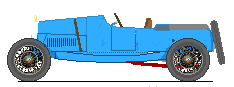
6 Carlo Masetti
Count C. Masetti
Bugatti T30 
12 Giulio Masetti
SA Italiana Ing. Nicola Romeo & C
Alfa Romeo RL TF 23 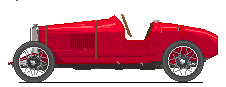
4 Alessandro Cappelli
A. Cappelli
Bianchi Corsa 18
GRAN PREMIO VETTURE
Montichiari Circuit, Brescia (I), 1 July 1923.
35 laps x 17.4 km (10.8 mi) = 609.0 km (378.4 mi)
| No. | Driver | Entrant | Car | Type | Engine |
|
| Category 2000 cc |
| 1 | Olivo Pellegatti | O. Pellegatti | S.I.A.M | | 2.0 | S-6 | DNA - Did not appear |
| 2 | Giorgio Rubbietti | SA Automobile e Velocipd. E. Banchi | Bianchi | Corsa 18 | 2.0 | S-4 |
| 3 | Sandro Ricci | S. Ricci | Ansaldo | 4CS | 2.0 | S-4 |
| 4 | Alessandro Cappelli | A. Cappelli | Bianchi | Corsa 18 | 2.0 | S-4 |
| 5 | Luigi Costa | L. Costa | Bugatti | T30 | 2.0 | S-8 |
| 6 | Carlo Masetti | Count C. Masetti | Bugatti | T30 | 2.0 | S-8 |
| |
| Category 1500 cc |
| 7 | Tommaso Saccomani | Società Anonima Giovanni Ceirano | Ceirano | CS2H | 3.0 | S-4 | DNA - Did not appear |
| 8 | Alfieri Maserati | A. Maserati | Diatto | 3000 | 3.0 | S-4 |
| 9 | Franco Boggio | Società Anonima Giovanni Ceirano | Ceirano | CS2H | 3.0 | S-4 |
| 10 | Pietro Cattaneo | Società Anonima Giovanni Ceirano | Ceirano | CS2H | 3.0 | S-4 | DNA - Did not appear |
| 11 | Antonio Ascari | SA Italiana Ing. Nicola Romeo & C | Alfa Romeo | RL TF 23 | 3.0 | S-6 |
| 12 | Enzo Ferrari | SA Italiana Ing. Nicola Romeo & C | Alfa Romeo | | 3.0 | S-6 | DNA - Did not appear |
| 13 | Giulio Masetti | SA Italiana Ing. Nicola Romeo & C | Alfa Romeo | RL TF 23 | 3.0 | S-6 |
| 14 | Luigi Pagani | Società Anonima Giovanni Ceirano | Ceirano | CS2 | 2.3 | S-4 |
| |
| Category Over 3000 cc |
| 15 | Emilio Materassi | E. Materassi | Diatto | 3000 | 3.0 | S-4 | DNA - Did not appear |
| 16 | Domenico Antonelli | Count D. Antonelli | Mercedes | 1914 GP | 4.5 | S-4 |
| 17 | Hermann Rützler | Österreichische Waffenfabriks Gesellschaft | Steyr | VI Sport 15/90 hp | 4.5 | S-6 | DNA - Did not appear |
| 18 | Gastone Brilli Peri | Count G. Brilli Peri | Fiat | 14B/S57A | 4.9 | S-4 |
| 19 | Guido Meregalli | G. Meregalli | Fiat | 14B/S57 | 4.5 | S-4 |
| 20 | Ogniben Alverà | O. Alverà | Fiat | 31A | 4.4 | S-4 |
| 21 | Vittorio Foroni | V. Foroni | Itala Spl | Hispano-Suiza | 6.3 | S-4 |
| 22 | Franco Caiselli | Count F. Caiselli | Packard | double-six | 4.9 | 2x6 | DNA - Did not appear |
| |
Count Carlo Masetti, victorious at Gran Premio Vetture
by Hans Etzrodt
|
Il Gran Premio Vetture on the Montichiari circuit near Brescia, received 22 entries but only 15 cars appeared at the start. Brilli Peri (Fiat) dominated the race from 1st to 15th lap. Ascari (Alfa Romeo)
retired after the first round followed by Maserati (Diatto), then Antonelli (Mercedes), Pagani (Ceirano) and Costa (Bugatti), who all disappeared before the 5th lap. After ten rounds when Alverà (Fiat),
Boggio (Ceirano) and Ricci (Ansaldo) had retired, the field was down to seven cars. Meregalli (Fiat) and Foroni (Itala Spl) withdrew by lap 15 with the field reduced to five cars. When Brilli Peri vanished
after 16 laps, the remaining four cars raced each other, until the end of lap 35. Count Carlo Masetti (Bugatti) finished first, his brother Count Giulio Masetti (Alfa Romeo) was 2nd, Cappelli (Bianchi) 3rd and
Rubbietti (Bianchi) came last.
|
The reviving of the Brescia road-circuit began by way of the great week of Brescia on Friday, 29. June with motorcycle races and the important Gran Premio Vetturette, the Voiturette Grand Prix, held over 522 km
on the Montichiari circuit. With only four finishers, Umberto Cagno (Fiat) was the celebrated victor, in 4h02m16.8s at 129.272 km/h average speed. Renzo (Bugatti) came second in 4h36m56.2s, Marconcini (Chiribiri)
finished third in 4h41m24.4s and De Sterling (Bugatti) was fourth in 4h52m10s. The fastest lap was driven by Cagno on lap 3 in 7m28.2s at 139.759 km/h.
Two days later, on Sunday, 1. July followed Gran Prenio Vetture, the large car Grand Prix, organized again by Ente Sportivo Bresciano, the Brescia Sports Organization, run on the same Montichiari circuit.
The course was used first in 1921, on level terrain just south-east of Brescia in the flatland of Montichiari. The triangular shaped course had the start near the beginning of a 6 km straight, heading south,
with three stands on the east side and pits opposite with start and finish, from where the drivers darted along the straight in clockwise direction. At its end a 1.3 km large avenue was built to bypass Montichiari.
Here the circuit tuned right and snaked along a 4.2 km road past Carneri and Santella. At its end were the crossroads of Ghedi with a wide right turn leading north along the 5.4 km straight which ended at Fascia d'Oro.
There it headed east along the 423-meter long Parabolica turn, connecting with the straight leading south. About one km further on was the finish. The racetrack was between ten and eight m wide, covered with macadam
and spread with tar to avoid dust development. The circuit length was 17.392 km abridged in the reports to 17.4 km with 35 laps to be covered, a total of 608.720 km abridged again to 609.0 km.
|
Entries:
Of the 22 entries only 15 cars started, which are all listed at the beginning of this report. Favorites for absolute victory were Count Giulio Masetti, Ascari, Maserati, Meregalli and Brilli Peri.
It was comprehensible that the Fiat company remained unable to participate, as it was very occupied at the French Grand Prix, held at the same time. Fiat had written to the Committee of the Brescia Club, informing
them that after the French GP their three cars driven by Bordino, Salamano and Giaccone would like to attempt achieving the world speed record on the roads of the Brescia circuit.
|
Start:
At nine o'clock the racecars were already in front of the pits where work was being done feverishly. When the authorities entered the enclosure, the royal march was played. The Minister of Industry and Commerce and
President of the Automobile Club of Italy, Hon. Rossi, and Hon. Bonardi and others were present. At 9:40 a.m. the drivers lined up in this order:
|
| |
| Category over 3000 cc |
| Start 10h00m |
18
Brilli Peri
Fiat
|
16
Antonelli
Mercedes
|
20
Alverà
Fiat
|
19
Meregalli
Fiat
|
21
Foroni
Itala Spl
|
| Category 3000 cc |
| Start 10h02m |
9
Boggio
Ceirano
|
8
Maserati
Diatto
|
13
G. Masetti
Alfa Romeo
|
11
Ascari
Alfa Romeo
|
14
Pagani
Ceirano
|
| Category 2000 cc |
| Start 10h04m |
3
Ricci
Ansaldo
|
2
Rubbietti
Bianchi
|
5
Costa
Bugatti
|
4
Cappelli
Bianchi
|
6
C. Masetti
Bugatti
|
|
Race:
Three minutes before the start, the engines were revved up and roared eagerly. At the starting line, the Undersecretary for Public Works, Mr. Sardi, carefully observed the timekeeper, Mr. Legnazzi, who was counting the
last seconds out loud. Mr. Sardi rapidly lowered the flag, and precisely at 10:00 a.m. the drivers in the over 3000 cc category took off. Brilli Peri (Fiat) was leading the group but Meregalli (Fiat) on the inside
tried to overtake him. However, Brilli managed to maintain first place by quickly picking up speed. At Montichiari he was leading the race. After two minutes the cars of 3000 category were leaving. Everyone started
off fast except for Maserati (Diatto), who had problems with his car that had to be pushed by the mechanic for quite a while. After another two minutes, at 10:04 the 2000 cc category cars started. Ricci (Ansaldo) was
in the lead followed by Carlo Masetti (Bugatti), who quickly overtook the opponents. A total of fifteen cars took off, five of each category.
Brilli Peri in the large Fiat was fastest and held the lead. Ascari (Alfa Romeo) had to slow down due to a broken water pipe, arriving late, and retired. Meanwhile, Boggio (Ceirano) already stopped in front of his
pit. The 15-car field was in the following order after the 1st lap:
| 1. | Brilli Peri (Fiat) | 7m49.8s |
| 2. | G. Masetti (Alfa Romeo) | 8m15.8s |
| 3. | Maserati (Diatto) | 8m23.2s |
| 4. | Antonelli (Mercedes) | 8m25.0s |
| 5. | Meregalli (Fiat) | 8m38.2s |
| 6. | Foroni (Itala Spl) | 8m39.2s |
| 7. | Cappelli (Bianchi) | 8m42.4s |
| 8. | C. Masetti (Bugatti) | 8m55.0s |
| 9. | Pagani (Ceirano) | 9m41.4s |
| 10. | Rubbietti (Bianchi) | 9m47.0s |
| 11. | Costa (Bugatti) | 9m54.0s |
| 12. | Alverà ((Fiat) | 10m02.0s |
| 13. | Boggio (Ceirano) | 10m13.2s |
| 14. | Ricci (Ansaldo) | 10m35.0s |
| 15. | Ascari (Alfa Romeo) | 15m27.4s |
On the second lap Brilli Peri (Fiat) was still in the lead, completing the two laps in 15m29.6s with Foroni (Itala Spl) second in 16m44.6s. During this lap Antonelli (Mercedes) stopped at the pits to change spark
plugs, while the unfortunate Maserati (Diatto) met with gearbox failure and was forced to pull out near the Ghedi turn. After the second lap, Costa (Bugatti) also withdrew. During the third lap Foroni (Itala Spl)
improperly overtook Pagani (Ceirano) in the Montichiari-Ghedi section, then hit the front wheel of Pagani's Ceirano, causing him to overturn on the side of the road where he fell into a ditch with the car.
Fortunately, the incident did not have serious consequences, as no one was injured but Pagani had to withdraw while Foroni's car continued the race. After the third lap Brilli Peri (Fiat) was still in the lead,
Foroni Itala Spl) was second and Alverà (Fiat) third. On the 4th lap, Giulio Masetti (Alfa Romeo) was forced to stop for a long time due to a broken rocker arm. He had no rivals in his category after the retirement
of Ascari and Maserati, mainly given Boggio's large slow-down. Antonelli (Mercedes) disappeared on the 4th lap from the race. Maserati (Diatto), Antonelli (Mercedes), Pagani (Ceirano) and Costa (Bugatti) disappeared
before the 5th lap with the field shrunk to ten cars in the following order after the 5th lap:
| 1. | Brilli Peri (Fiat) | 38m50.6s |
| 2. | Foroni (Itala Spl) | 40m56.2s |
| 3. | C. Masetti (Bugatti) | 41m44.6s |
| 4. | Cappelli (Bianchi) | 42m09.6s |
| 5. | Meregalli (Fiat) | 42m12.2s |
| 6. | Rubbietti (Bianchi) | 48m07.06 |
| 7. | Ricci (Ansaldo) | 54m37.6s |
| 8. | G. Masetti (Alfa Romeo) | 1h00m36.0s |
| 9. | Alverà ((Fiat) | 1h03m29.8s |
| 10. | Boggio (Ceirano) | 1h25m12.4s |
On the 6th lap, Capelli was doing very well but had to change one tire. On the 9th lap Alverà had to retire. After ten laps Brilli Peri (Fiat) was in the lead and had a good 5-minute advantage over Foroni
(Itala Spl). After Alverà (Fiat), Boggio (Ceirano) and Ricci (Ansaldo) disappeared, the field had dwindled to seven cars. Brilli completed the 10 laps with an average speed of 133.686 km/h in the following
order after the 10th lap, 174 km:
| 1. | Brilli Peri (Fiat) | 1h18m05.6s |
| 2. | C. Masetti (Bugatti) | 1h22m40.0s |
| 3. | Foroni (Itala Spl) | 1h23m26.4s |
| 4. | Meregalli (Fiat) | 1h24m43.2s |
| 5. | Rubbietti (Bianchi) | 1h33m25.6s |
| 6. | Cappelli (Bianchi) | 1h36m10.4s |
| 7. | G. Masetti (Alfa Romeo) | 1h39m50.4s |
After the 11th lap Carlo Masetti (Bugatti) stopped to refill gasoline and checked the engine. Brilli Peri (Fiat) was in the lead and first in his category. Carlo Masetti was competing in the 2-liter category.
After another four laps, the slow but steady improvement of Meregalli (Fiat) advanced him into second place. The field was in the following order after the 14th lap:
| 1. | Brilli Peri (Fiat) | 1h51m08.4s |
| 2. | Meregalli (Fiat) | 1h57m54.0s |
| 3. | C. Masetti (Bugatti) | 2h00m01.0s |
| 4. | Foroni (Itala Spl) | 2h00m34.6s |
| 5. | Rubbietti (Bianchi) | 2h09m14.8s |
| 6. | Cappelli (Bianchi) | 2h10m07.8s |
| 7. | G. Masetti (Alfa Romeo) | 2h19m29.2s |
On the 15th lap Brilli Peri arrived at the finish line with a smoking engine. He requested water and got away after a few minutes. Foroni (Itala Spl) arrived in dismay and withdrew due to melted bearings,
while Meregalli (Fiat) did not appear as he withdrew due to a failure of the distribution gear. Brilli Peri (Fiat) remained the leader with an average speed of 131.750 km/h, then the 5-car field was in the
following order after the 15th lap:
| 1. | Brilli Peri (Fiat) | 1h58m54.6s |
| 2. | C. Masetti (Bugatti) | 2h17m01.0s |
| 3. | Cappelli (Bianchi) | 2h10m07.8s |
| 4. | G. Masetti (Alfa Romeo) | 2h19m29.2s |
| 5. | Rubbietti (Bianchi) | 2h26m18.4s |
Brilli Peri's victory seemed assured, yet he lost first place on the 16th lap because he stopped again at his pit for fuel and oil and restarted only 17 minutes later. Then again, he was forced to stop on the
next lap due to a backfire that ignited the gasket of one of the exhaust pipes. The fire spread to a water pipe which forced him to stop for good. The crowd applauded for the unlucky driver. The race had now
lost almost all its interest while Carlo Masetti took the lead. He completed 18 laps, half the race at an average speed of 123.248 km/h. Cappelli held second place. At about mid-race, the field was in the
following order after the 18th lap:
| 1. | C. Masetti (Bugatti) | 2h32m44.6s |
| 2. | Cappelli (Bianchi) | 2h35m31.8s |
| 3. | Rubbietti (Bianchi) | 2h46m34.4s |
| 4. | G. Masetti (Alfa Romeo) | 2h49m36.0s |
Capelli refueled on the 20th lap while Masetti was still in the lead. Rubbietti lost some minutes when he broke the accelerator spring, with the following times after the
20th lap, 348 km:
| 1. | C. Masetti (Bugatti) | 2h49m11.0s |
| 2. | Cappelli (Bianchi) | 2h52m11.8s |
| 3. | G. Masetti (Alfa Romeo) | 3h05m18.8s |
| 4. | Rubbietti (Bianchi) | 3h15m32.2s |
Carlo Masetti refueled on the 24th lap together with Rubbietti, who was three laps behind. Meanwhile, Cappelli (Bianchi) had a sudden skid at the Ghedi turn, leading to a rollover. He amazingly saved himself,
and the car did not suffer any damage. He rightened the car and resumed the race. However, he wrecked a tire and thus lost precious minutes. On the 25th lap (435 km) Carlo Masetti was leading at an average
speed of 121.881 km/h with the following times after the 25th lap:
| 1. | C. Masetti (Bugatti) | 3h34m08.6s |
| 2. | Cappelli (Bianchi) | 3h41m37.8s |
| 3. | G. Masetti (Alfa Romeo) | 3h46m41.6s |
| 4. | Rubbietti (Bianchi) | 4h05m07.4s |
On the 26th lap Giulio Masetti (Alfa Romeo) was pushing his car at high speed, regaining significant ground, but a new incident stopped him and forced him to change all four tires and work the brakes which took
about half an hour. Meanwhile, Capelli (Bianchi) was passing Carlo Masetti (Bugatti) - who stopped for almost three minutes changing spark plugs - so that by the 30th lap (522 km) the positions were as follows:
with the 4-car field in the following times after the 30th lap, 522 km:
| 1. | C. Masetti (Bugatti) | 4h21m35.4s |
| 2. | Cappelli (Bianchi) | 4h23m18.6s |
| 3. | G. Masetti (Alfa Romeo) | 4h27m29.0s |
| 4. | Rubbietti (Bianchi) | 4h51m14.0s |
The battle between Carlo Masetti (Bugatti) and Cappelli (Bianchi) continued to be interesting until the 33rd lap; after Cappelli, who ruined the left rear wheel hub in the fall, had to give up the unequal battle
and was forced to slow down, allowing Giulio Masetti (Alfa Romeo), who made a rapid recovery in the last laps, to overtake Cappelli. The final order showed: 1st Carlo Masetti, 2nd Giulio Masetti, 3rd Cappelli,
4th Rubietti. The victory of Bugatti was welcomed by the spectators with sympathy but only moderate interest.
|
Results
| Pos. | No. | Driver | Entrant | Car | Type | Engine | Laps | Time/Status | Diff |
|
| 1. | 6 | Carlo Masetti | Count C. Masetti | Bugatti | T30 | 2.0 | S-8 | 35 | 5h03m22.6s | |
| 2. | 12 | Giulio Masetti | SA Italiana Ing. Nicola Romeo & C | Alfa Romeo | RL TF 23 | 3.0 | S-6 | 35 | 5h17m05.0s | + 13m42.4s |
| 3. | 4 | Alessandro Cappelli | A. Cappelli | Bianchi | Corsa 18 | 2.0 | S-4 | 35 | 5h23m54.2s | + 20m31.6s |
| 4. | 2 | Giorgio Rubbietti | SA Automobile e Velocipd. E. Banchi | Bianchi | Corsa 18 | 2.0 | S-4 | 35 | 5h37m43.4s | + 34m20.8s |
| DNF | 17 | Gastone Brilli Peri | Count G. Brilli Peri | Fiat | 14B/S57A | 4.9 | S-4 | 17 | fire damage |
| DNF | 20 | Vittorio Foroni | V. Foroni | Itala Spl | Hispano | 6.3 | S-4 | 14 | engine bearings |
| DNF | 18 | Guido Meregalli | G. Meregalli | Fiat | 14B/S57 | 4.5 | S-4 | 14 | mechanical |
| DNF | 9 | Franco Boggio | Società Anonima Giovanni Ceirano | Ceirano | CS2H | 3.0 | S-4 | 9 | mechanical | |
| DNF | 3 | Sandro Ricci | S. Ricci | Ansaldo | 4CS | 2.0 | S-4 | 9 | mechanical | |
| DNF | 19 | Ogniben Alverà | O. Alverà | Fiat | 31A | 4.4 | S-4 | 9 | mechanical |
| DNF | 15 | Domenico Antonelli | Count D. Antonelli | Mercedes | 1914 GP | 4.5 | S-4 | 3 | mechanical |
| DNF | 13 | Luigi Pagani | Società Anonima Giovanni Ceirano | Ceirano | CS2H | 3.0 | S-4 | 2 | wheel-damage | |
| DNF | 5 | Luigi Costa | L. Costa | Bugatti | T30 | 2.0 | S-8 | 2 | mechanical | |
| DNF | 8 | Alfieri Maserati | A. Maserati | Diatto | 3000 | 3.0 | S-4 | 1 | gearbox | |
| DNF | 10 | Antonio Ascari | SA Italiana Ing. Nicola Romeo & C | Alfa Romeo | RL TF 23 | 3.0 | S-6 | 1 | broken water pipe |
| |
Fastest lap Gastone Brilli Peri (Fiat) on lap 1 in 7m39.4s = 136.4 km/h (84.7 mph).
Winner's average speed 2000 cc (C. Masetti): 120.4 km/h (74.8 mph).
Winner's average speed 3000 cc (G. Masetti): 115.2 km/h (71.6 mph).
Weather: overcast, dry.
|
|
|
In retrospect:
The intermediate times sometimes differed among the sources. We think to have chosen the correct times.
The 1923 Gran Premio Vetture was widely unheard of, since the French GP was held at the same time.
|
Primary sources researched for this article:
AUTOMOBIL-REVUE, Bern
Corriere della Sera, Milano
El Mundo Deportivo, Barcelona
Il Popolo di Brescia, Brescia
La Nuova Italia Sportiva, Roma
La Stampa, Torino
Special thanks to:
Giuseppe Prisco
Alessandro Silva
|
|

12 Henry Segrave
Sunbeam Motor Car Co Ltd
Sunbeam
7 Albert Divo
Sunbeam Motor Car Co Ltd
Sunbeam

6 Ernest Friedrich
Automobiles Ettore Bugatti
Bugatti T32 Tank
GRAND PRIX DE L'AUTOMOBILE CLUB DE FRANCE
Tours (F), 2 July 1923 (Monday).
35 laps x 22.830 km (14.186 mi) = 799.050 km (496.5 mi)
| No. | Driver | Entrant | Car | Type | Engine |
|
| 1 | René Thomas - Lhermit | Automobiles Delage | Delage | 2LCV | 2.0 | V-12 |
| 2 | KenelmLee Guinness - Perkins | Sunbeam Motor Car Co Ltd | Sunbeam | | 2.0 | S-6 |
| 3 | Albert Guyot - Létigny | SA des Etablissements | Rolland-Pilain | | 2.0 | S-8 |
| 4 | Pietro Bordino - Bruno | Fiat SpA | Fiat | 805 | 2.0 | S-8 |
| 5 | Arthur Duray - Blanc | SA des Aéroplanes G. Voisin | Voisin | | 2.0 | S-6 |
| 6 | Ernest Friedrich - Rohfritsch | Automobiles Ettore Bugatti | Bugatti | T32 Tank | 2.0 | S-8 |
| 7 | Albert Divo - Hivernet | Sunbeam Motor Car Co Ltd | Sunbeam | | 2.0 | S-6 |
| 8 | Jules Goux | SA des Etablissements Rolland-Pilain | Rolland-Pilain | | 2.0 | S-6 | DNS - did not start |
| 9 | Enrico Giaccone - Carignano | Fiat SpA | Fiat | 805 | 2.0 | S-8 |
| 10 | Andre Lefèbvre - Fortin | SA des Aéroplanes G. Voisin | Voisin | | 2.0 | S-6 |
| 11 | Pierre de Vizcaya - Etienne | Automobiles Ettore Bugatti | Bugatti | T32 Tank | 2.0 | S-8 |
| 12 | Henry Segrave - Paul Dutoit | Sunbeam Motor Car Co Ltd | Sunbeam | | 2.0 | S-6 |
| 13 | Victor Hémery - Gaston Delalande | SA des Etablissements Rolland-Pilain | Rolland-Pilain | | 2.0 | S-8 |
| 14 | Carlo Salamano - Ferretti | Fiat SpA | Fiat | 805 | 2.0 | S-8 |
| 15 | Henry Rougier - Lalaurie | SA des Aéroplanes G. Voisin | Voisin | | 2.0 | S-6 |
| 16 | Pierre Marco - Ernest Zirn | Automobiles Ettore Bugatti | Bugatti | T32 Tank | 2.0 | S-8 |
| 17 | André Morel - Chanu | SA des Aéroplanes G. Voisin | Voisin | | 2.0 | S-6 |
| 18 | Bertrand de Cystria - Georges Lutz | Automobiles Ettore Bugatti | Bugatti | T32 Tank | 2.0 | S-8 |
Segrave wins the French Grand Prix with Sunbeam
by Hans Etzrodt
|
Delage, Rolland-Pilain, Voisin and Bugatti were to defend the French colors against Fiat from Italy and Sunbeam from Britain, representing all racing nations, except for America, whose cars
had become unsuitable for road racing and Germany, whose cars were not allowed into ACF contests, the club that organized the 800 km race on the Tours circuit. The main battle was between
Bordino (Fiat) and Guinness (Sunbeam). When Bordino retired on lap eight, Guinness took the lead until he pitted on lap 12, when Giaccone (Fiat) held the lead up to lap 17 to refuel and
Salamano (Fiat) secured the lead until his stop for fuel on lap 19 to let Divo (Sunbeam) lead for three laps. On lap 22 Salamano regained the lead from Divo, which he held with ease until
lap 33 when he retired. Segrave (Sunbeam), the last of the seven leaders, had driven regularly and inherited the lead, which he kept over the last two laps to win the race. The ACF this
year again experienced little pleasure with their Grand Prix. This time the honor fell again abroad. Victors were in 1914 the Germans, 1921 the Americans, 1922 the Italians and 1923 the British.
|
Planned as the greatest event of the year, the Grand Prix did not attain its prewar importance when many nations were participating to fight for victory. After the Great War in 1921, the French
Grand Prix had been transformed into an invitational race. As a result, German and Austrian cars and drivers could not participate since they were not invited. The IX French Grand Prix was
held on a Monday, preceded by the motorcycles on Saturday and the touring car Grand Prix on Sunday, when the surface of the dirt roads was torn apart, exposing masses of stones.
The 22.830 km triangular Touraine circuit was about 15 km north of Tours. The start near Pailleterie was on Route Nationale 158, heading south towards Tours along a straight of nearly 8 km to
La Membrolle (the closest point to Tours). In the heart of this town was a right hairpin bend heading north-west on Nationale Route 159 for about 8 km to La Boileau. There a sharp right turn
led in north-east direction along Departmental Crossroad 48 through the town of Semblançay to La Noue Gouérinet, where a right hairpin bend joined onto Route 158, back to the nearby start.
In 1923 some sections of the road were cambered so steeply that drivers of touring cars had to work hard to stay on the road, intimidatingly lined with poplars or fences. David Hodges in his
book, The French Grand Prix, wrote "The drivers agreed that the circuit was dangerous: 'once down in the camber' some cars refused to steer back onto the crown of the road', it was poorly
surfaced, with many potholes, narrow and dusty."
|
Entries:
Delage decided to race again in 1923 after nine years of absence. Planchon and Lory designed the 2LCV Grand Prix car with a 1992 cc (51.4 x 80 mm) four overhead camshaft V-12 engine, initially
giving 95 hp at 6000 rpm. The first test drives showed that the car was overheating easily. Despite this problem and after lengthy discussions it was eventually decided to start the not ready
car at the French Grand Prix and René Thomas was to drive it.
Sunbeam entered three cars for Guiness, Divo and Segrave. Their 1923 car was a departure from previous year's design, thanks to former Fiat designer Vincenzo Bertarione with Louis Coatalen.
The car had a 1988cc (67 x 94 mm) 6-cylinder engine, twin o.h.c. with two valves per cylinder, capable of 108 hp at 5000 rpm and 180 km/h. Both engine and bodywork showed close resemblance
to the 804 Fiat from 1922.
Rolland Pilain entered three cars, two with the 8-cylinder engine for Guyot and Hémery, while Goux drove a car with a 6-cylinder sleeve-valve engine, designed by the Swiss Dr. Schmid with
Ernest Henry. The 6-cylinder car broke down with engine failure either when driven to the race or during practice and it did not appear for scrutineering. The cars were made in Tours. For
the 1923 Grand Prix the engineer Grillot improved the 1922 2-Liter car with hydraulic front brakes and a nice streamlined tail, painted light blue. The 1983 cc (59.7 x 90 mm) straight-eight
engine with a ball bearing crank, twin o.h.c. 16-valves, produced 75 hp and speeds of 175 km/h.
Fiat entered three cars for Bordino, Giaccone and Salamano, all were the new supercharged type 805 with a 1,979 cc (60 x 87.5 mm), straight 8 twin o.h.c. engine, producing 146 hp at 5,500 rpm
and 195 km/h top speed. Fiat was first using a supercharged engine in Grand Prix racing, like Mercedes had done earlier at Indianapolis.
Voisin, one of the early aircraft pioneers, entered four cars for Duray, Lefêbvre, Rougier and Morel. The 1923 Grand Prix cars were designed with a new streamlined wing-shaped body with
entirely flat under-floor. The 1978 cc (62 x 110 mm) 6-cylinder sleeve-valve engine produced 90 hp at 4400 rpm with a top speed of 175 km/h.
Bugatti also entered four cars, called the T32 'Tank', for Ernst Friedrich, Pierre de Vizcaya, Pierre Marco and Prince Bertrand de Cystria. They used the 1922 8-cylinder type 30, 1989 cc
(60 x 88 mm) engine with three valves per cylinder but now with a roller bearing crankshaft also on the big ends and split rods. The cars had an extremely streamlined beetle-like 2-seat
body with a very short wheelbase of 200 cm and a body that restricted the forward view for the drivers, the full width of the car was covered including the wheels, capable of 180 km/h top speed.
The entries were fascinating due to the introduction by Delage of the first V-12 cylinder engine in Grand Prix racing. Similarly exciting were the latest Fiats equipped with a supercharger,
the fastest cars in the field. Newly designed streamlined bodies were introduced by Voisin and Bugatti. So it was to be a very interesting race.
|
Practice:
After practice, all drivers agreed about the poor condition of the roads which were too much cambered to allow safe driving at high speeds. The road surface had suffered from the wheels of
the touring cars the day before at their Grand Prix. Informed groups of people were concerned for the race about the loosened stones that posed a serious danger to radiators and fuel tanks.
But more serious was the excessive cambering of the road and the many bumps, also the soft ground to both sides of the road. To drive at the highest possible speeds was unthinkable.
Scrutineering and weighing of the cars took place in the small town of Semblançay, in the park of the stands on June 29, three days before the race. The order was as follows: 9:00 AM: the
3 Sunbeams; 9:30: 3 Rolland-Pilains; 10:00: 3 Fiats; 10:30: 4 Voisins; 2:00 PM: 3 Bugattis; 2:30: the #18 Bugatti and 1 Delage. The minimum unloaded weight had to be at least 650 kg.
The weight of the cars was as follows:
| No. 1 Thomas (Delage) | 704 kg |
| No. 2 Giunness (Sunbeam) | 675 kg |
| No. 3 Guyot (Rolland-Pilain) | 842 kg |
| No. 4 Bordino (Fiat) | 705 kg |
| No. 5 Duray (Voisin) | 758 kg |
| No. 6 Friedrich (Bugatti) | 761 kg |
| No. 7 Divo (Sunbeam) | 670 kg |
| No. 8 Goux (Rolland-Pilain) | DNS |
| No. 9 Giaccone (Fiat) | 706 kg |
| No. 10 Lefêbvre (Voisin) | 772 kg |
| No. 11 de Vizcaya (Bugatti) | 755 kg |
| No. 12 Segrave (Sunbeam) | 678 kg |
| No. 13 Hémery (Rolland-Pilain) | 822 kg |
| No. 14 Salamano (Fiat) | 699 kg |
| No. 15 Rougier (Voisin) | 752 kg |
| No. 16 Marco (Bugatti) | 757 kg |
| No. 17 Morel (Voisin) | 773 kg |
| No. 18 de Cystria (Bugatti) | 823 kg |
|
Race:
Tours was flooded by a crowd of enthusiasts and by cars. The day of the race, a Monday, was a clear sunny morning and in the first morning hours overfilled cars rushed in endless processions
to the large grandstands.
Fifteen minutes before the start, the 17 cars lined up about 200 meter from the start line, two per row in order of their race numbers, which had been decided by ballot.
|
| | | | |
 |
1
Thomas
Delage
|
2
Guinness
Sunbeam
|
|
3
Guyot
Rolland-Pilain
|
4
Bordino
Fiat
|
5
Duray
Voisin
|
6
Friedrich
Bugatti
|
|
7
Div
Sunbeam
|
9
Giaccone
Fiat
|
10
Lefêbvre
Voisin
|
11
de Vizcaya
Bugatti
|
|
12
Segrave
Sunbeam
|
13
Hémery
Rolland-Pilain
|
14
Salamano
Fiat
|
15
Rougier
Voisin
|
|
16
Marco
Bugatti
|
17
Morel
Voisin
|
18
de Cystria
Bugatti
|
|
A motor cyclist served as pacemaker up to the white line, next to the timekeeper's stand. Jean-Maurice Giglieux informed us that the rider was Meunier on an Alcyon, a champion rider and
leader of the Alcyon racing team. The Marseillaise was played and the crowd removed their headgear. The many people around the cars
cleared off the track, leaving only officials and journalists. After the engines were cranked to live, the cars followed the pacing motorcyclist towards the starting line where he pulled to
the side and exactly at eight o'clock René de Knyff, President of the ACF Sporting Commission, lowered the yellow flag for the rolling start. Bordino's red Fiat from the second row in a spurt
passed Guinness (Sunbeam) and Thomas (Delage) and held the lead when passing the last grandstands.
At the south-east point of the triangular course was the hairpin of La Membrolle. Bordino arrived first at an incredible speed and took the hairpin in nice style, while making a hellish
racket with the siren-like wailing sound of the supercharger. The Fiat skidded just very little and immediately straightened out to disappear. A hail of little stones rained down and a large
cloud of dust settled slowly to the ground. Before one had recovered from this demonstration, the entire pack descended like an avalanche with the Delage of Thomas at the lead. The whole
group whirled past, so fast, that one could hardly think, far from watching something near. Then Vizcaya drove into the dense cloud of dust which had not yet settled down. Next, a common
outcry when the car crashed into the outer fencing and ripped down ten meters of this trellis. Everything disappeared in a large cloud of dust. The spectators had scattered paniclike
apart. Soon after the ambulance car arrived, it was learned that Vizcaya had a minor head injury, more serious his mechanic, a boy, and likewise a grown up spectator. Fifteen spectators
were injured, three seriously, others escaped with slight abrasions. The Bugatti had retired on its wheels stopped by a tree. In a hurry, workers re-erected the ripped down fence. After
the first lap Bordino (Fiat) had eclipsed all his practice times, leading after 9m45s. He was 41 seconds clear of Guinness (Sunbeam), Thomas (Delage) and Giaccone (Fiat). The third Fiat
of Salamano was fifth followed by Segrave and Divo. After the first lap it was clear that Fiat and Sunbeam were the fasted cars. The order of the 16-car field was as follows after
the first lap:
| 1. | Bordino (Fiat) | 9m45s |
| 2. | Guinness (Sunbeam) | 10m26s |
| 3. | Thomas (Delage) | 10m26s |
| 4. | Giaccone (Fiat) | 10m35s |
| 5. | Salamano (Fiat) | 11m11s |
| 6. | Segrave (Sunbeam) | 11m16s |
| 7. | Divo (Sunbeam) | 11m32s |
| 8. | Guyot (Rolland-Pilain) | 11m46s |
| 9. | Friedrich (Bugatti) | 12m01s |
| 10. | Hémery (Rolland-Pilain) | 12m30s |
| 11. | Duray (Voisin) | 12m33s |
| 12. | Marco (Bugatti) | 12m43s |
| 13. | Rougier (Voisin) | 12m57s |
| 14. | Lefêbvre (Voisin) | 14m27s |
| 15. | Morel (Voisin) | 14m33s |
| 16. | De Cystria (Bugatti) | 14m35s |
On the second lap the first nine drivers held their position with a few changes in the back of the field. Bordino's advantage to Guinness was 75 seconds after two laps. On the third lap Thomas
dropped from third to eighth place as his engine overheated. Marco's Bugatti dropped to the tail. On the fourth lap he stopped at the downhill section ahead of the finish to retire from where
the mechanic pushed the car behind the pits. Segrave fell behind with his clutch slipping. Divo gained fourth place when he passed Salamano's Fiat who had scraped along the barrier at
Semblançay and lost over two minutes. The fast passing of the La Membrolle hairpin required special skill. At this critical place the Fiats were by far the fastest. They arrived at such
high speed, that it was hardly possible to keep the cars on the strongly cambered road. On lap five, Bordino was leading ahead of Guinness, Giaccone, and Salamano who had repassed Divo.
Bordino's average lap time during the first five laps was 9m44s. After 114.150 km, he was 2m20s ahead of Guinness with the 15-car field in the following order after 5 laps:
| 1. | Bordino (Fiat) | 48m41s |
| 2. | Guinness (Sunbeam) | 51m01s |
| 3. | Giaccone (Fiat) | 53m22s |
| 4. | Salamano (Fiat) | 53m40s |
| 5. | Divo (Sunbeam) | 53m52s |
| 6. | Thomas (Delage) | 55m21s |
| 7. | Guyot (Rolland-Pilain) | 55m44s |
| 8. | Segrave (Sunbeam) | 56m13s |
| 9. | Friedrich (Bugatti) | 59m32s | 1 lap behind |
| 10. | Rougier (Voisin) | 59m57s | 1 lap behind |
| 11. | Hémery (Rolland-Pilain) | 1h01m01s | 1 lap behind |
| 12. | Morel (Voisin) | 1h05m42s | 1 lap behind |
| 13. | Duray (Voisin) | 1h05m56s | 1 lap behind |
| 14. | De Cystria (Bugatti) | 1h09m04s | 2 laps behind |
| 15. | Lefêbvre (Voisin) | 1h10m19s | 2 laps behind |
On the sixth lap Divo dropped from fifth to eighth place, allowing Thomas to advance, who after a very creditable run with the overheating Delage retired in fifth place on lap seven.
The reason given by the team was as a result of a flung stone from the tires piercing his fuel tank, others claimed that the radiator had been holed by a flying stone. Hémery stopped the
Rolland-Pilain at his pit to correct something on his engine. He started again but retired on lap eight with a broken oil pump. As he was one lap behind, he completed only six laps.
After the eighth lap Bordino led Guinness by 3m49s, but on the following lap he stopped on the straight after Membrolle but then the Italian rejoined to stop again and retired. It was
assumed that the supercharger broke, damaged by circuit dust and grit sucked in. Another reasons given was due to the impact with a stone breaking through the oil pan. Peter Helck in
A.Q. Vol.21, No.1, wrote that "Bordino's mad drive ended when dust and road grit paralyzed his supercharger." Helck, who was present at this race, watched from a less crowded place:
"Here on the roadside verge we could see, hear and feel the impact of this fight for leadership. Bordino's thrashing pace showered us with road grit; immediately afterwards Guinness
peppered us with still more fragments of Touraine's Circuit." After Bordino's retirement, Guinness in the Sunbeam found himself leading the French Grand Prix, which was the first time
in Grand Prix history that a green car from Britain led the field. On lap nine, Morel in the Voisin ended his race but was disqualified because he had been assisted with help by
others. He completed only seven laps, as he was one lap behind. Prince de Cystria drove into the soft sand at La Membrolle hairpin. It took him a while to free the Bugatti before
he continued to retire. As he was two laps behind, he completed only six laps. After the ninth lap the field had shrunk to ten cars. Guinness had increased his lead to Giaccone.
His average lap time during the last five laps was 10m25s. After 228.3 km, the field was in the following order after 10 laps:
| 1. | Guinness (Sunbeam) | 1h43m06s |
| 2. | Giaccone (Fiat) | 1h47m04s |
| 3. | Salamano (Fiat) | 1h47m14s |
| 4. | Guyot (Rolland-Pilain) | 1h49m59s |
| 5. | Divo (Sunbeam) | 1h50m11s |
| 6. | Segrave (Sunbeam) | 1h52m24s |
| 7. | Friedrich (Bugatti) | 1h57m57s | 1 lap behind |
| 8. | Rougier (Voisin) | 1h58m25s | 1 lap behind |
| 9. | Lefêbvre (Voisin) | 2h20m58s | 3 laps behind |
| 10. | Duray (Voisin) | 2h24m38s | 3 laps behind |
At the end of the eleventh lap, Divo stopped at his pit to drop off his mechanic Hivernet, who had been injured by a flying stone and took Moriceau on board. This stop allowed Guyot
in his Rolland-Pilain to gain fourth place, passing Divo. But during the twelfth lap Divo regained fourth place ahead of Guyot and Segrave. Guinness stopped on the 13th lap for fuel,
oil and water. As the Sunbeam left his pit, Guinness lost his lead as both Fiats passed and the Italians were in the first two places with Giaccone in the lead.
On lap 14, Guinness dropped from third to sixth place, losing around 10 minutes at the pits due to a slipping clutch which advanced Divo into third place. Giaccone was still leading
ahead of Salamano, Divo, Guyot, Segrave, Guinness, Friedrich and the Voisins of Lefêbvre, Duray and Morel at the tail.
On the 17th lap Giaccone stopped at the pits, changed spark plugs, rear wheel and refilled fuel and oil. Restarting was a problem and Giaccone rejoined in fifth place, now over seven
minutes behind Salamano, who was the new leader, ahead of Guyot who had passed Divo. On lap 18, Guyot in second place stopped for around seven minutes and rejoined in fourth place while
Divo gained second place. On lap 19, Salamano stopped for about 5 minutes at his pits, refilled fuel and oil and changed one wheel. He rejoined in second place, while Divo had taken
the lead. When Giaccone stopped again, he worked for ten minutes at his car which did not want to restart and he retired with a broken exhaust valve on lap 19, while others guessed a
supercharger problem. The field was down to nine cars. On the 20th lap Divo was leading Salamano and Segrave. When Rougier retired the Voisin, the field was down to eight cars. As
Rougier was one lap down, he completed only 18 laps. Divo's average lap time during the last five laps was 10m0s with the field in the following order after 20 laps:
| 1. | Divo (Sunbeam) | 3h40m08s |
| 2. | Salamano (Fiat) | 3h40m59s |
| 3. | Segrave (Sunbeam) | 3h43m01s |
| 4. | Guyot (Rolland-Pilain) | 3h47m30s |
| 5. | Guinness (Sunbeam) | 3h53m11s | 1 lap behind |
| 6. | Friedrich (Bugatti) | 3h56m42s | 1 lap behind |
| 7. | Duray (Voisin) | 4h30m32s | 5 laps behind |
| 8. | Lefêbvre (Voisin) | 4h34m01s | 5 laps behind |
After the 20th lap the field had settled down. Sunbeam still had a complete team while Fiat lost Bordino and Giaccone. Bugatti had only Friedrich. Delage had retired and Voisin had
still Duray and Lefêbvre. On lap 22 Salamano passed Divo, maintaining a race speed of nearly 125 km/h. On lap 24 Duray dropped to last place. After 25 laps Salamano led Divo's
Sunbeam by 2m20s. This procession continued until lap 29, when Guyot retired due to a broken oil pump. After 30 laps Salamano held a lead of four minutes ahead of Divo. Salamano's
average lap time during the last five laps was 11m0s with the 7-car field was in the following order after 30 laps:
| 1. | Salamano (Fiat) | 5h28m48s |
| 2. | Divo (Sunbeam) | 5h32m59s |
| 3. | Segrave (Sunbeam) | 5h38m02s |
| 4. | Guinness (Sunbeam) | 5h57m25s | 2 laps behind |
| 5. | Friedrich (Bugatti) | 6h00m06s | 2 laps behind |
| 6. | Duray (Voisin) | 6h40m02s | 6 laps behind |
| 7. | Lefêbvre (Voisin) | 6h41m16s | 6 laps behind |
On the 31st lap Salamano was in the lead when Divo in second place stopped to refuel. But the fuel tank filler cap was unknowingly turned the wrong way by mistake, and seized. More
than 15 minutes were spent trying to loosen the cap with a variety of tools. Eventually, it was decided to use the small 2-gallon spare fuel tank under the dash which had to be filled
every lap. At the end of the 31st lap Salamano led in 5h39m55s, ahead of Segrave in 5h49m44s who had passed Divo 6h02m04s, now about 12 minutes behind Segrave. Duray retired his
Voisin on lap 31, but completed only 24 laps as he was six laps behind. After lap 32 Salamano led in 5h50m50s, ahead of Segrave in 6h00m59s, Divo 6h14m42s, Guinness 6h21m47s, Friedrich
6h23m25s and Lefêbvre six laps behind.
On lap 33, the leading Fiat of Salamano failed to appear past the grandstands at the expected time. The car had stopped apparently out of fuel. Then Segrave arrived at the stands in
first place after 6h12m35s. An official announcement was not yet made about the missing Fiat, when one could see Ferretti, the mechanic of Salamano, came running from the nearby hill
to reach the Fiat pit to fetch gasoline. The crowd got on their feet and cheered on the running man. Totally exhausted, Ferretti reached his pits after a two kilometer sprint. The
Fiat pits decided to replace the mechanic with another one to bring a fuel container to the stranded car. Amongst excited cheers by the crowd the new mechanic rushed back with a large
red can. He had not yet covered 50 meters, when one of the officials ran after the mechanic and called him back among raging calls of protest by the crowd. Meantime the Fiat pit had
found a bicycle ready for the original mechanic. But Ferretti also did not get far when officials ordered him to walk back to the car. As a result the giant crowd in the stands got
in monstrous loud agitation. Apparently the Fiat did not run out of gas but the car assumedly broke down with supercharger failure. However, Angelo Tito Anselmi wrote in his Fiat book
that Bordino's withdrawal was due to the impact with a stone (some versions say "swallowed" by the compressor, others aimed at breaking through the oil pan). The 805s of Salamano and
Giaccone were in fact delayed by self-ignition and detonation phenomena typical of a very high temperature and average specific pressure of the gaseous mixture, with spark plugs of
inadequate thermal grade". Sebastian Faurès Fustel de Coulanges in his book Fiat en Grand Prix wrote about Salamano's retirement, that obviously, something was no longer working
correctly: the supercharger.
Segrave who regularly had maintained third place, inherited the lead and drove with intermittent misfiring. Divo stopped now every lap to refill his spare fuel can, losing much time.
Guinness in third place was two laps down, followed by Friedrich's Bugatti and Lefêbvre in last place. On the last lap Guinness lost about two minutes at La Membrolle, when he stalled
the car with a problem of restarting the engine due to his valves being badly burnt. This enabled Friedrich to pass him for third place. Segrave's average lap time during the last
five laps was 11m27s. After Segrave crossed the finish line after 6h35m19.6s, he drove one additional lap as the winner was not shown a finishing flag. Divo was one lap down,
Friedrich and Guinness two laps and Lefêbvre was six laps behind. Each car kept driving until it had covered the required 35 laps, leaving the Voisin of Lefêbvre as the only car on
the course to complete four laps which took over 45 minutes. After the race Segrave was celebrated with honour by the Interior Minister while the band played the British anthem and
afterwards the Marseillaise.
|
Results
| Pos. | No. | Driver | Entrant | Car | Type | Engine | Laps | Time/Status | Diff |
|
| 1. | 12 | Henry Segrave | Sunbeam Motor Car Co Ltd | Sunbeam | | 2.0 | S-6 | 35 | 6h35m19.6s |
| 2. | 7 | Albert Divo | Sunbeam Motor Car Co Ltd | Sunbeam | | 2.0 | S-6 | 35 | 6h54m25.8s | + 19m06.2s |
| 3. | 6 | Ernest Friedrich | Automobiles Ettore Bugatti | Bugatti | T32 Tank | 2.0 | S-8 | 35 | 7h00m22.4s | + 25m02.8s |
| 4. | 2 | Lee Guinness | Sunbeam Motor Car Co Ltd | Sunbeam | | 2.0 | S-6 | 35 | 7h02m03.0s | + 26m43.4s |
| 5. | 10 | Andre Lefèbvre | SA des Aéroplanes G. Voisin | Voisin | | 2.0 | S-6 | 35 | 7h50m29.2s | + 1h15m09.6s |
| DNF | 14 | Carlo Salamano | Fiat SpA | Fiat | 805 | 2.0 | S-8 | 32 | engine |
| DNF | 3 | Albert Guyot | SA des Etablissements Rolland-Pilain | Rolland-Pilain | | 2.0 | S-8 | 28 | oil pump |
| DNF | 5 | Arthur Duray | SA des Aéroplanes G. Voisin | Voisin | | 2.0 | S-6 | 24 | mechanical |
| DNF | 15 | Henry Rougier | SA des Aéroplanes G. Voisin | Voisin | | 2.0 | S-6 | 18 | mechanical |
| DNF | 9 | Enrico Giaccone | Fiat SpA | Fiat | 805 | 2.0 | S-8 | 18 | exhaust valve |
| DNF | 4 | Pietro Bordino | Fiat SpA | Fiat | 805 | 2.0 | S-8 | 8 | supercharger |
| DNF | 17 | André Morel | SA des Aéroplanes G. Voisin | Voisin | | 2.0 | S-6 | 7 | disqualified |
| DNF | 18 | Bertrand de Cystria | Automobiles Ettore Bugatti | Bugatti | T32 Tank | 2.0 | S-8 | 6 | mechanical |
| DNF | 13 | Victor Hémery | SA des Etablissements Rolland-Pilain | Rolland-Pilain | | 2.0 | S-8 | 6 | oil pump |
| DNF. | 1 | René Thomas | Automobiles Delage | Delage | 2LCV | 2.0 | V-12 | 6 | fuel tank |
| DNF | 16 | Pierre Marco | Automobiles Ettore Bugatti | Bugatti | T32 Tank | 2.0 | S-8 | 3 | mechanical |
| DNF | 11 | Pierre de Vizcaya | Automobiles Ettore Bugatti | Bugatti | T32 Tank | 2.0 | S-8 | 0 | crash |
| |
Fastest lap: Pietro Bordino (Fiat) on lap 2 in 9m36s = 142.187 km/h official, 142.7 km/h (88.7 mph) correct.
Winner's average speed: 121.3 km/h (75.4 mph).
Weather: sunny and dry.
|
|
|
In retrospect:
Since the French Grand Prix in 1906, it was for the first time at the 1923 French Grand Prix that the top speed was timed with an electrical Fluxmeter over a 150 meter distance.
| Bordino (Fiat) | 198 km/h |
| Friedrich (Bugatti) | 183 km/h |
| Divo (Sunbeam) | 182 km/h |
| Guinness (Sunbeam) | 182 km/h |
| Segrave (Sunbeam( | 178 km/h |
| Thomas (Delage) | 174 km/h |
| Salamano (Fiat) | 172 km/h |
| Giaccone (Fiat) | 170 km/h |
| Duray (Voisin) | 168 km/h |
| Guyot (Rolland-Pilain) | 166 km/h |
| Lefêbvre (Voisin) | 162 km/h |
| De Cystria (Bugatti) | 155 km/h |
| Morel (Voisin) | 155 km/h |
| Rougier (Voisin) | 155 km/h |
|
Primary sources researched for this article:
Allgemeine Automobil-Zeitung, Wien
AUTOMOBIL-REVUE, Bern
Englebert Magazine, Liège
L'Auto, Paris
Le Miroir des Sports, Paris
MOTOR, Berlin
Omnia, Paris
Special thanks to:
Jean-Maurice Giglieux
|
|
|
